
Chained Beasts Demo Enemies: Archers, Wrestlers and Shields
The updated Demo preview identifies archers, pinning wrestlers and shielded swordsmen. Learn their documented roles and distinguish advice from verified counters.
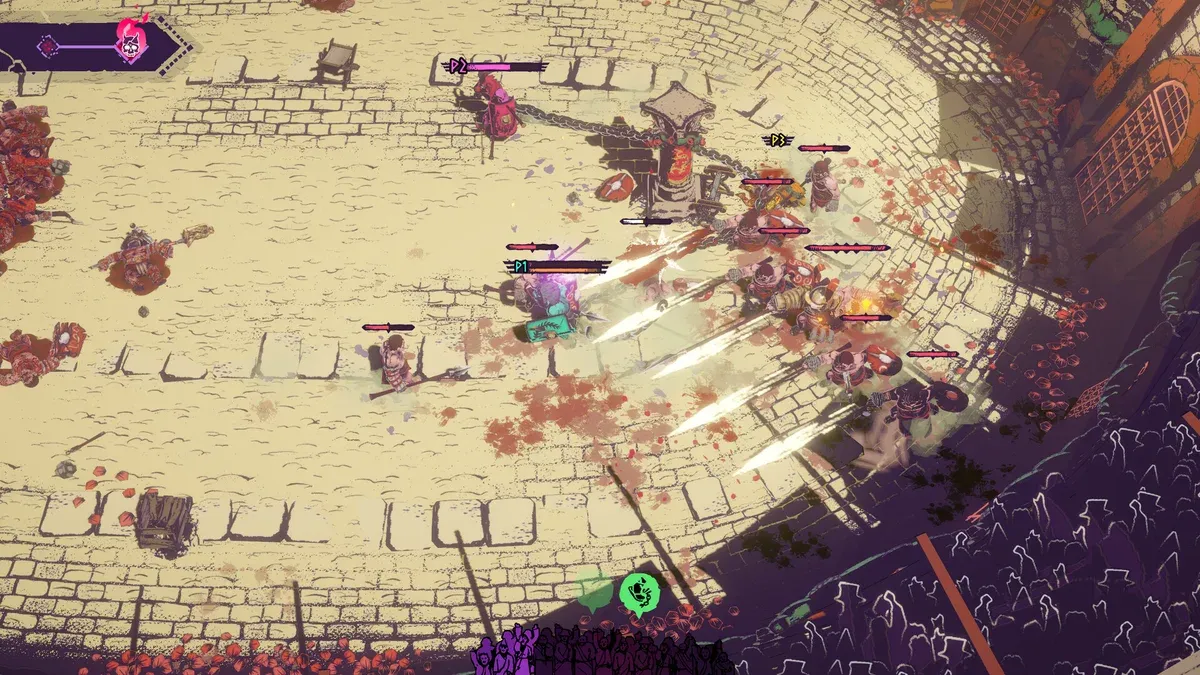
Which enemy roles did the updated Demo preview name?
The June developer preview explicitly describes three roles: archers using range, wrestlers pinning gladiators until an ally rescues them, and defensive swordsmen attacking from behind shields. Those descriptions are more useful than treating every opponent as the same close-range target.
| Enemy role | Described behavior | Detail not supplied |
|---|---|---|
| Archer | Attacks from range | Exact projectile speed, damage or a guaranteed dodge window |
| Wrestler | Pins a gladiator until a teammate rescues them | Universal solo escape input or exact rescue timing |
| Defensive swordsman | Attacks behind a shield | A complete weakness, guard-break or resistance table |
The source concerns the updated Demo. It does not identify every full-game enemy, every spawn or every version of these behaviors. Use the current game and version-labelled footage before turning a role description into a complete launch strategy.
What should a party consider when ranged enemies are present?
Our recommendation is to include the ranged threat when choosing a route and avoid focusing only on the nearest enemy. Discuss where the group will move and whether the path creates a safe follow-up after an attack or throw.
This is positioning advice, not a claim that a particular object always blocks projectiles or that every attack can be interrupted. The arena hazard guide identifies environmental interactions the developer actually names. It should not be expanded into an undocumented cover system.
How should you prepare for the described wrestler interaction?
The preview specifically mentions teammate rescue, so a cooperative group should pay attention when someone loses control of their position. Announce the problem and determine which ally can respond rather than continuing to pull the chain in a different direction.
The source does not explain the full solo case, the required input or a repeatable interrupt window. We do not supply those missing instructions from another game’s mechanics. Use the chain teamwork guide for communication principles and check the current tutorial for actual actions.
What does a shielded enemy description establish?
It establishes a defensive role. It does not prove an elemental weakness, a universal backstab bonus or a specific guard-break combo. When a tactic appears effective, identify the build, action and conditions before treating it as a rule for every shielded opponent.
Keep the player’s shield system separate from an enemy’s complete behavior. The shield rework reference documents historical player-equipment changes, but it is not a full enemy AI specification.
How should an enemy guide grow after release?
Add the current name, observed moves and relevant footage for each entry, then distinguish a repeated behavior from one example. Numerical health, damage, resistance and timing claims need comparable evidence. A promotional screenshot or an old Demo description is not enough to fill every field of a bestiary.
For general decision-making while those details are being verified, use combat fundamentals. The goal is to recognize the kind of problem an enemy creates without pretending that an announcement contains a complete tested counter for it.
Sources and verification
Sources reviewed October 15, 2026. Official statements, historical details and platform guidance are identified in the relevant sections. This article is source-based; no hands-on game test is claimed.
See our editorial policy for evidence standards and corrections.
Related Articles
co-op
Chained Beasts Chain Tactics: Move and Fight as a Team
Coordinate movement, avoid tangling around obstacles and use your chain deliberately with these practical Chained Beasts co-op principles.
co-op
Chained Beasts Cross-play and Platforms: Confirmed Details
Check the official Chained Beasts platforms, cross-play announcement and the limits of what has been confirmed about shared progress.
co-op
Chained Beasts Local Co-op and Remote Play Together
Set expectations for Chained Beasts couch co-op, controllers and Steam Remote Play Together without assuming unverified mixed-session support.
Was this helpful?
Thanks for the feedback!